
Winter Miles
A Week of Winter Training With The Canadian Women's Rowing Team

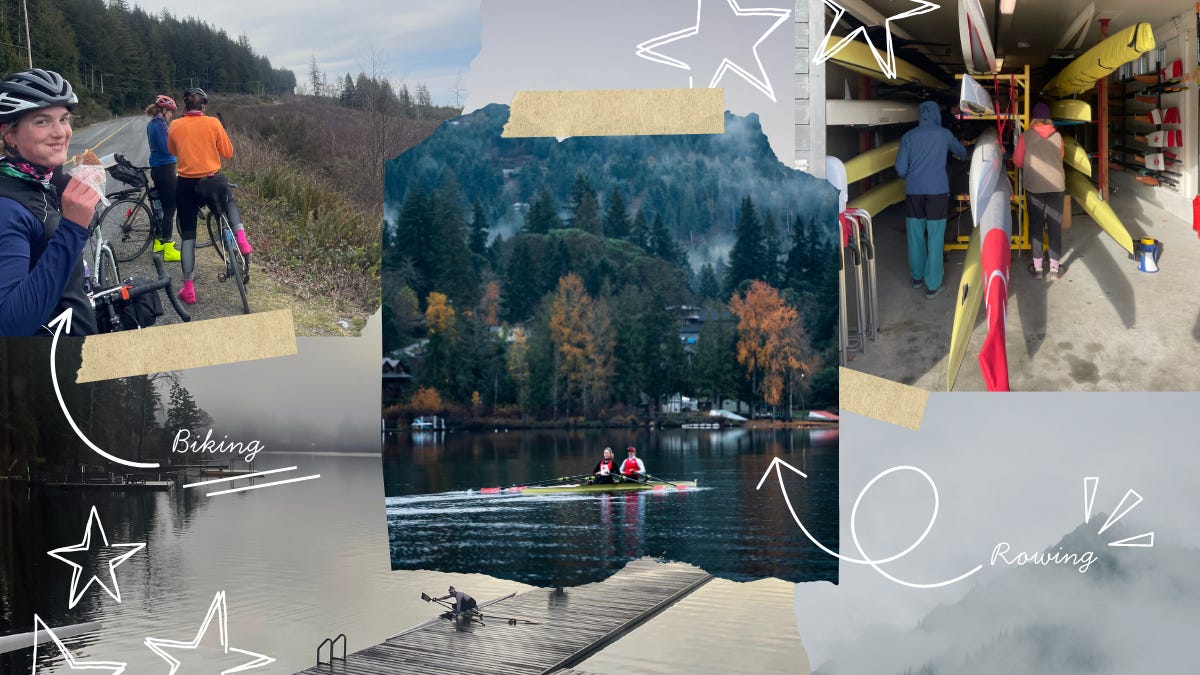
For me, endurance training is not about achieving extraordinary feats of athletic capacity, but rather about the willingness to experience discomfort and endure it for an extended period. For some, winter training is an appealing time to test the limits of personal stamina and autonomously experiment with cross-training modalities to complete the long hours. For most, winter training encompasses never-ending workouts, a constant craving for carbs, and the skill of sleeping 9 hours, yet still feeling exhausted. Colloquially, this is referred to as the ‘grind’ of training for rowing. Contrary to some conceptions, winter training is the ‘off’ season that actually demands a greater commitment of time and energy than the competition season. Although this type of training can seem mundane, it lays the foundation for the aerobic capacity necessary to row a 2km race and is therefore essential to the sport.
This article breaks down a high-volume week with the Canadian Women’s National Rowing Team to give you an idea of what typical training is like during the winter. I have left out session specifics to protect the confidentiality of our tailored performance program, but you’ll get the gist.
Disclaimer: For any enthusiastic recreational or competitive rowers out there, please note that this training is prescribed to experienced full-time athletes and should not be taken as inspiration for your next training week. Volume should be modified according to personal capabilities to prevent the risk of injury and energy deficiency.
Monday
8:15- 10:30 am Row: 22km on water steady state, Boat: Women’s 2X
12:00 pm 80 min VO2 Max Erg: long interval erg session (intensity is around 6km pace with a 2:1 work to rest ratio)
2:30 pm Cross-train: 90 minute bike
A big start to the week, but I enjoyed my first time in the double with Avalon Wasteneys! Both of us hold most of our experience in sweep rowing, but for Avalon, this season is an opportunity to apply her longstanding passion for rowing to a new discipline, capitalizing on the flexibility in our training plan to explore curiosities in novel ways. For me, it is a method to diversify some of my training. Ultimately, you never know where your true strengths on a team could lie until you’ve experimented with different boat classes and styles. I would rather be open to sculling and realize through trial and error that it may not be my strength, than to never try and not know.
The day is separated by an hour to 90-minute breaks between sessions to refuel and recover for the next. 6km pacing isn’t my strong suit; I struggled through a lingering cough but persisted with the support of my teammates. During one of the rest periods, my teammate Elisa ran to grab me a throat lozenge to help me breathe easier (you rock Elisa). The compassion and support my teammates provide transform individual workouts into collective challenges that make each effort more manageable.
Tuesday
8:15- 10:30 am 28 km Row steady state on water, Boat: Women’s 4-
12:00 - 1:30 pm Strength and Conditioning
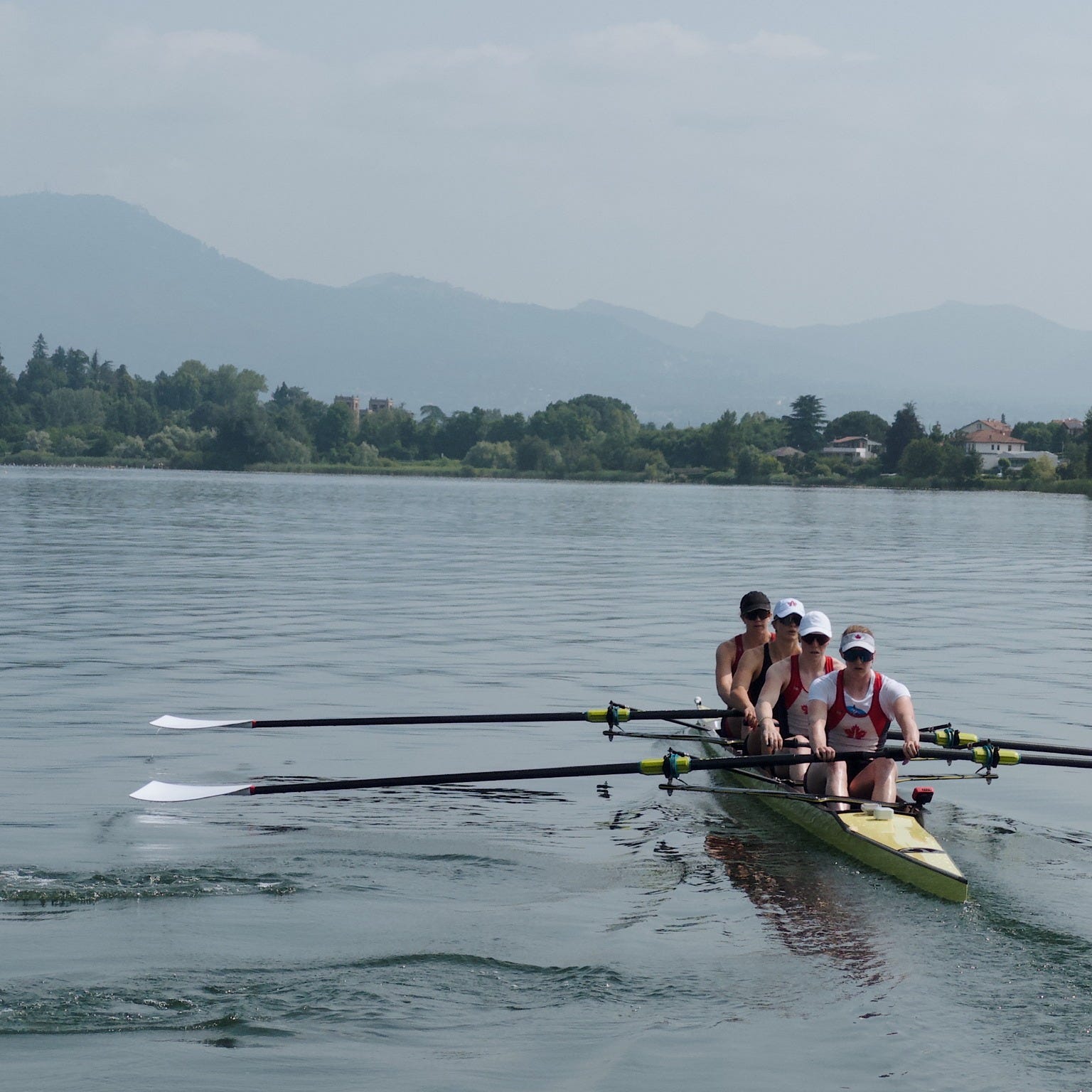
In Tuesday’s row I had the pleasure of ticking off 28km in my current favourite boat class, the women’s 4-. The boat is composed of four rowers without a coxswain (The smaller person who steers the bigger boats and yells at the rowers). The 4- uniquely combines the best qualities of small and big boat rowing. It is light enough to feel your impact on the boat, yet large enough to foster camaraderie among teammates. Each member of a 4- holds a large stake in the boat, allowing for more direct communication and opportunity to collaborate. Compared with a crew boat like an 8+, individual voices can get lost in the crowd, and more opinions can make reaching a consensus difficult. Albeit, both have their advantages, and I am honestly content in any boat with another person to share the thrill of racing.
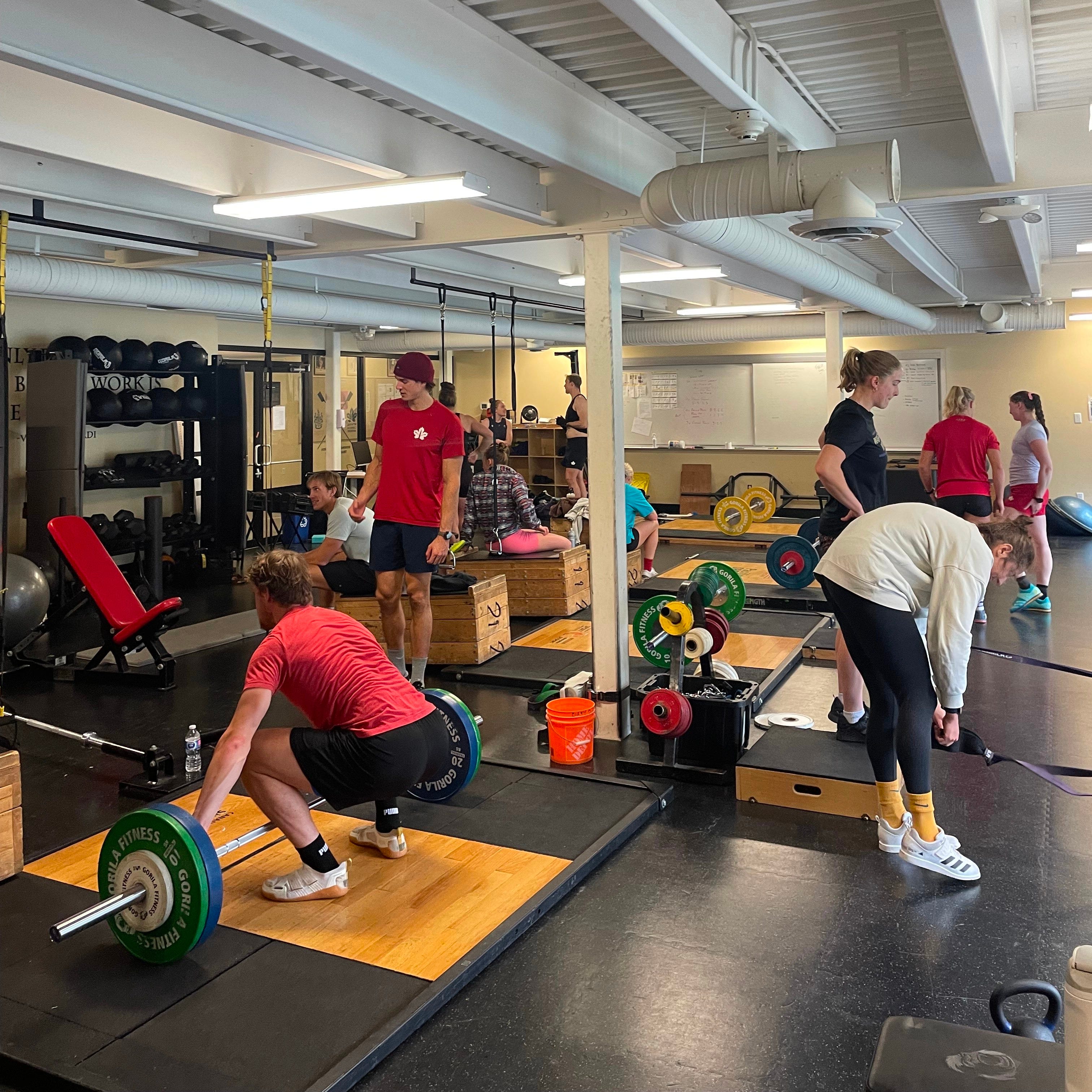
The objectives for strength and conditioning are kept simple to complement the priority sessions on the water. Our mixed-modality program combines general strength, functional movement, and stability exercises to improve overall muscle efficiency, balance in the boat, and heighten power potential. Key movements for today’s session include deadlifts, snatches, and pushup variations. Strength sessions are essential to improving wattage and muscular endurance during training while also reducing the risk of injury.
Wednesday
8:15-9:45 am 80 min Erg steady state
11:30- 1:15 pm 20 km Row steady state on water, Boat: Women’s 4-
Any time 80 min of yoga/ mobility
This is the time of the week when getting out of bed qualifies as the fourth workout of the day. Fatigue has claimed the spotlight, and it’s only Wednesday! Luckily, I employ some mental techniques to get me through the long and sometimes monotonous workouts. While erging, I’ll listen to high energy songs, set the screen display to watts, and focus on the immediate feedback from my force curve. I like to take advantage of the erg’s stability and consistently focus on technical cues to translate optimal patterns to on water rowing.
It is much easier to lose track of time on the water because of the intense mental focus required for each stroke, especially for coordination in a crew boat. Once we’ve gone through a warm-up progression, we will mix in some rolling drills and break up the km’s with rate steps. Despite the long week ahead, small wins and recognition of progress help strengthen the motivation to keep going.
One of the biggest game changers for me was improving my mobility. I learned over the past year that it is impossible to row effectively if I cannot get my body into the proper position. Rather than chasing speed with more watts, using your mechanics to your advantage makes the work sustainable and supports the boat speed. Mobility also reduces the risk of injury by minimizing compensatory load displacement, a byproduct of suboptimal postures in the boat.
Thursday
8:15-10:45 am 28 km Row mostly steady state with some rate changes, Boat: Women’s 4-
12:00 - 1:30 pm Strength and Conditioning
You’ve guessed it, another long row to kick off Thursday. For this workout, however, my crew has stayed the same for the past two days, which lets us fine-tune our adjustments and dial in our balance and timing. I prefer to stay with the same combination for more than one session because it allows us to carry over what we learn from the first to the next, gradually building comfort before layering in more technical skill. And after 28km, I reward myself with some sweet carbs from a local bakery just up the road from the boathouse.
Our strength and conditioning follows the same objectives throughout the week, but heavier compound lifts are emphasized in this session since our ‘recovery’ is approaching and overreaching is less of a concern. We’ll practice our cleans, front squats, weighted pull-ups, bench press, and core stability. This is my favourite point in the week to witness just how powerful my teammates truly are and bring the hype by cheering them on. What I love about rowing is its polarizing training. Despite the long hours of cardio we’ve endured this week, we all strive to push ourselves to the limit in the weight room. My teammate Kris does three pull-ups with a 20-kilogram plate, while Elisa does three front squats at 90 kilograms. My goal is to embrace the struggle and enjoy the elation when one of us hits a new personal best.
Friday
8:15- 10:00 am 20 km Row steady state on water, Boat: Women’s 8+
12:00 - 1:30 pm 60 min Erg. Interval session pushing to 103% of our most recent 2km erg test wattage.
This is the last day of official centralized training before our volume block, when we can individualize our week to get the hours done in a way that suits our needs. Although we prioritize smaller boats in the winter to maximize the effects of volume training, there is value in staying familiar with the 8+. It is rewarding to get out with almost all of my teammates (Katie can keep up in the 1X), and it is beneficial to practice coordinating our efforts and matching our drive speeds to keep up with a faster boat. Compared to 28kms in a 4-, 20kms in an 8+ feels like a short tech row.
We finish off the day with a short interval ergometer session to reintroduce racing speed of movement and find efficiency at 103% of our 2km effort. The intervals include three blocks of short bursts at a 1:1 work-to-rest ratio. This work-to-rest ratio gives us just enough time to recover between repetitions while still challenging our lactate tolerance. With a VO2 max test coming up, we’ll get to test the effectiveness of this training!
Saturday
Day one of Volume Block
8:15 - 10:30 am 24 km Row steady state on water, Boat: Women’s 1X
11:30 - 1:00 pm Strength and Conditioning
2:00 - 4:20 pm 140 min Bike
I quickly realized that the midweek luxury of being boated in the 4- and 8+ would not extend to the volume block when I am boated for the single. On the bright side, everyone here today is also in the single, which is ideal for some meaningful side-by-side work. We all meet up 7km from our starting point to begin 2 hours of continuous low-rate switches to keep focus high. Notably, we include 1 km stretches at a stroke rate of 16, which challenges our balance and forces us to make our drive time (the half of the stroke where the blades are in the water) as effective as possible.
The final strength and conditioning workout of the week covers a few major lifts but primarily challenges our muscular endurance through high-rep bodyweight exercises. We practice back squats and rows for strength, and we finish with high-repetition arm, glute, and core work that leaves me more sore the next day than any other workout. This type of strength training enhances our muscular endurance and bodyweight proficiency, supporting sustained, high-quality rowing postures even after long hours of training.
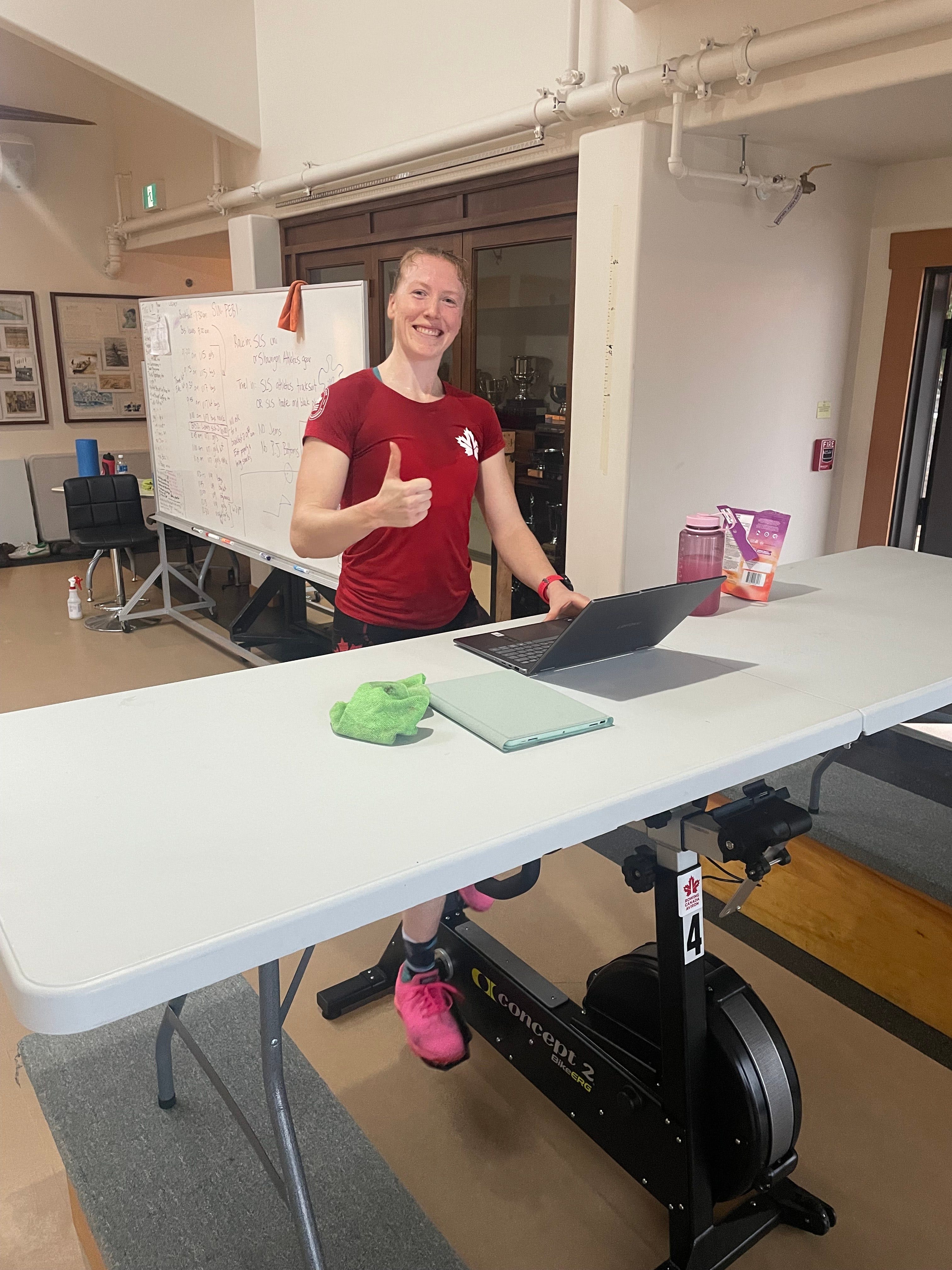
Lastly, we finish the day with a long bike ride, usually made easier by distractions like watching a movie, old race videos, or setting up a table to get some computer work done. These are the toughest workouts for me- not just for my mental grit, but for the absolutely horrible discomfort of the bike seat. For strategies on how to make biking more enjoyable, please ask someone else, I’m still figuring it out.
Sunday
200 min Crosstrain
Although we are required to train on Sunday, we can choose to sleep in, which for me means we still get a recovery day. With the flexibility to choose our own adventures, some of my teammates travel to warmer climates, while others plan local bike trips. It is an opportunity to step away from the sometimes repetitive routines of daily training, so we can recharge our motivation for rowing by next Monday. I believe a major misconception among newer athletes is that they should resist taking time away from the sport. I strongly encourage regular breaks to reduce burnout and give your body space to consolidate the training. I have found that when I step back, I can return with a revitalized focus on technical improvements and a refreshed attitude toward my training goals. Training is not just about putting in the hours; it’s about maintaining your health and enjoyment to sustain longevity in the sport.
Final Tally
Rowing kms: 142
Erg minutes: 250
Strength and Conditioning minutes: 280
Cross-training minutes: 430