
The Point is to Fail
How Becoming Your Best Means Embracing the Worst

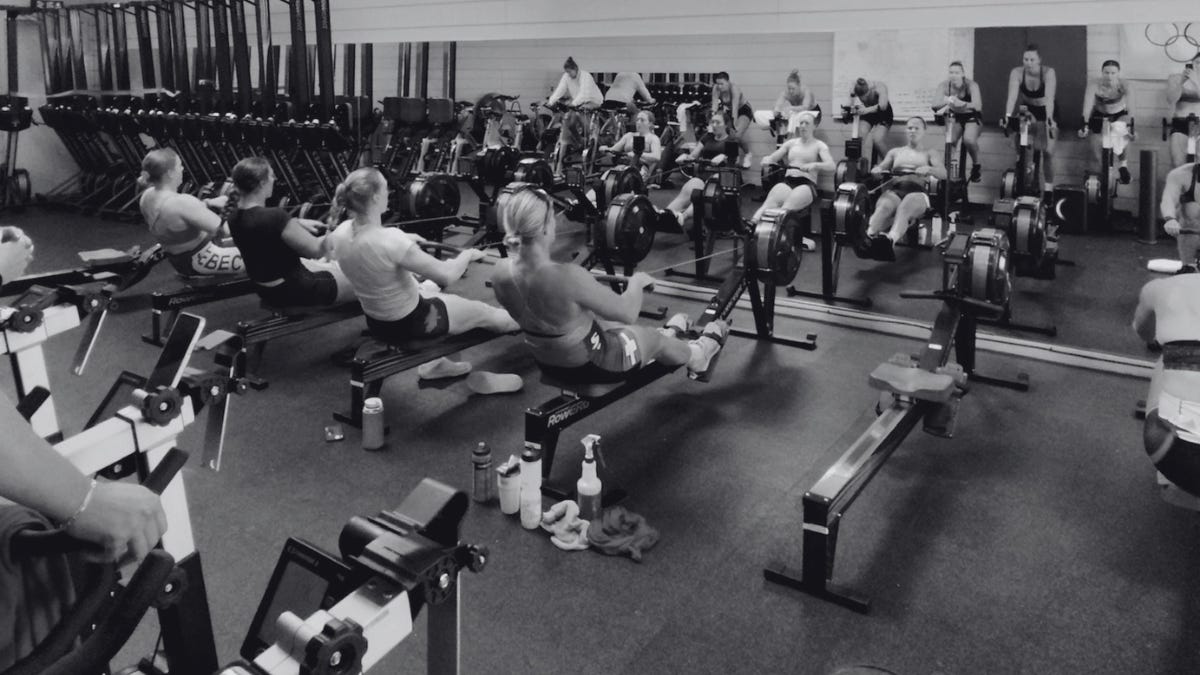
On a random Saturday in April, when most of my friends are enjoying their start to a spring weekend, I’m instead dry heaving outside a boathouse.
Bits of rain fall over me like some cinematic picture straight out of a Nike commercial that I didn’t ask to star in. As I lean on the side railing for support, I try to imagine, gasp by gasp, that the air is supplying the oxygen my legs are so desperately needing. It’s not. In reality, the longer I stand immobilized, the more my quads cramp out of exhaustion, feeling like some twisted construction worker is methodically replacing my muscle with wet concrete, fibre by fibre. This isn’t exactly how younger me pictured the standard mid-twenties weekend, but nevertheless, I wouldn’t have it any other way.
This moment was brought to you by 1km all-out repeats, rate-capped at 24 strokes per minute. A borderline abusive session that is one of the most challenging, but somehow also one of my favourites.
There’s an uncomplicated simplicity to the workout prescription that discourages thinking and values an unwavering brutality to attack each stroke. The goal is to courageously begin the 1km as hard as you can at a rate of 24, and then manage the physiological consequences of your actions as the piece progresses. The rate cap and intensity are what challenge your absolute mental and physical endurance. At rate 24, you have just enough time between each drive to process how much the last hurt, and make the conscious decision to do it again. And again. And again. Regardless of fitness, the work demands that you persevere despite every signal from your body telling you to stop.
Returning to the shelter of the boathouse, a little more wet and a little less nauseous than before, I can’t help but feel a tinge of disappointment when I review the workout summary on my erg. My power output, though impressive from the beginning, follows a drastic trajectory in the opposite direction. The kind of regression that might require medical attention from those first aid tents at races. I know from experience that I would achieve a faster overall average score if I paced the 1km segments, a concept that is drilled into novice rowers from the beginning. In my mind, watching my splits fade over the workout was like watching a doomed soldier in a war movie. Confident and heroic at the beginning, only to be devastatingly injured, yet stubbornly continuing on. Limping dramatically through the trenches, the ending felt like my legs waving a little white flag stroke by stroke until the timer finally put them out of their misery.
Like any reasonable athlete on the verge of a spiral, I go to my coach asking for reassurance that this battle isn’t the best indicator for the war. I express my concern that if I pace the work, I’ll end up with a better result, A lower split average across all pieces. Putting on his sports psychology hat, he considers my perspective and somewhat begrudgingly responds:
“This is the most uncomplicated workout. You literally just go, and then go again on the next stroke. The score doesn’t matter…The objective is to get comfortable with the discomfort”
Annoyingly, he has a point.
I realized that what I have been programmed to strive for is not relevant at all in this case. Typically, erg outputs are based in objectivity, and what matters is the best overall average you can produce. For example, on a 2k erg test, it doesn’t matter if you had a heroic first 500 meters; it’s the total time to completion that gets recorded. I’ve spent years understanding these fundamentals, which naturally makes it disorienting to be told that in this instance, the final number is what’s important.
Comparison with my previous scores in this session or with how my other teammates consistently hold the same split is irrelevant. Failure, I cannot stress this enough, is the whole point.
Last year, when I didn’t understand the strategy of this workout, I hit it “correctly”, consistently hitting 1:42 piece after piece and inching faster overall times each week. What did this teach me? I can hold around a 1:43 at rate 24. Not exactly applicable to racing and not exactly informative on what’s going on internally.
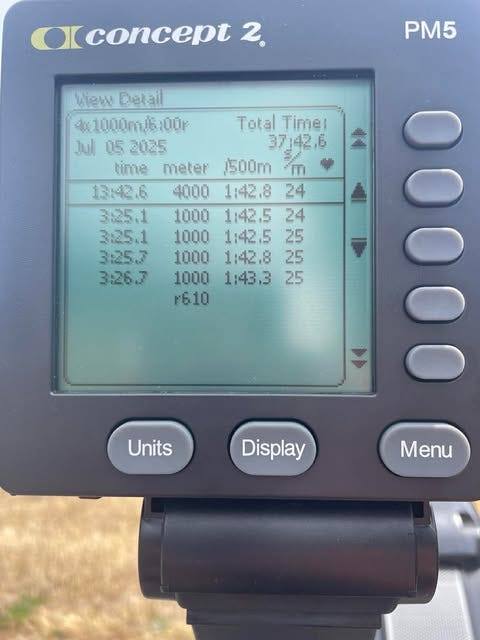
4x1km Summer 2025.
This year, approaching the work correctly means practicing reaching maximal capacity, sitting in that discomfort, and choosing to keep going. Understanding that the burn that hits at 700 meters in the first piece, 200 in the second, to right off the start in the third and fourth, is a sensation that means I am pushing and an opportunity to experience my willingness to fight.
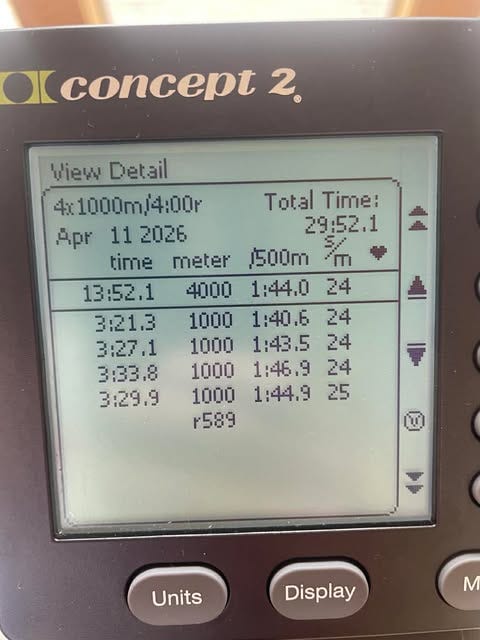
4x1km Spring 2026
The objective score is worse, but the outcome is much more applicable to athletic growth. It shows a certain kind of progress that isn’t visible in the numbers. Every push that might prove to be a failure, in reality, is expanding my limits, incrementally pushing the ceiling that will eventually contribute to my best performance.
Tough workout. I would be interested in what the recovery time between pieces was and how that recovery was managed - that is, by walking around, stretching, lightly rowing? Also, was the coach's intent primarily psychological (i.to manage discomfort, or to learn to be consistent - very different) or is there a specific system (power, muscular endurance, lactic acid tolerance) physiologically that was to be trained? I always found that when I understood the intent and system being trained it helped me to get the most out of it. Perhaps more framing from the coach ahead of time would be helpful. As someone who raced 1,000 m internationally from 1979 to 1984 then raced 2,000 m internationally from 1985 to 1988 we did approach the races somewhat differently and trained somewhat differently too.