
Sunshine and Strong Coffee
Training Journal: Chula Vista Camp 2026

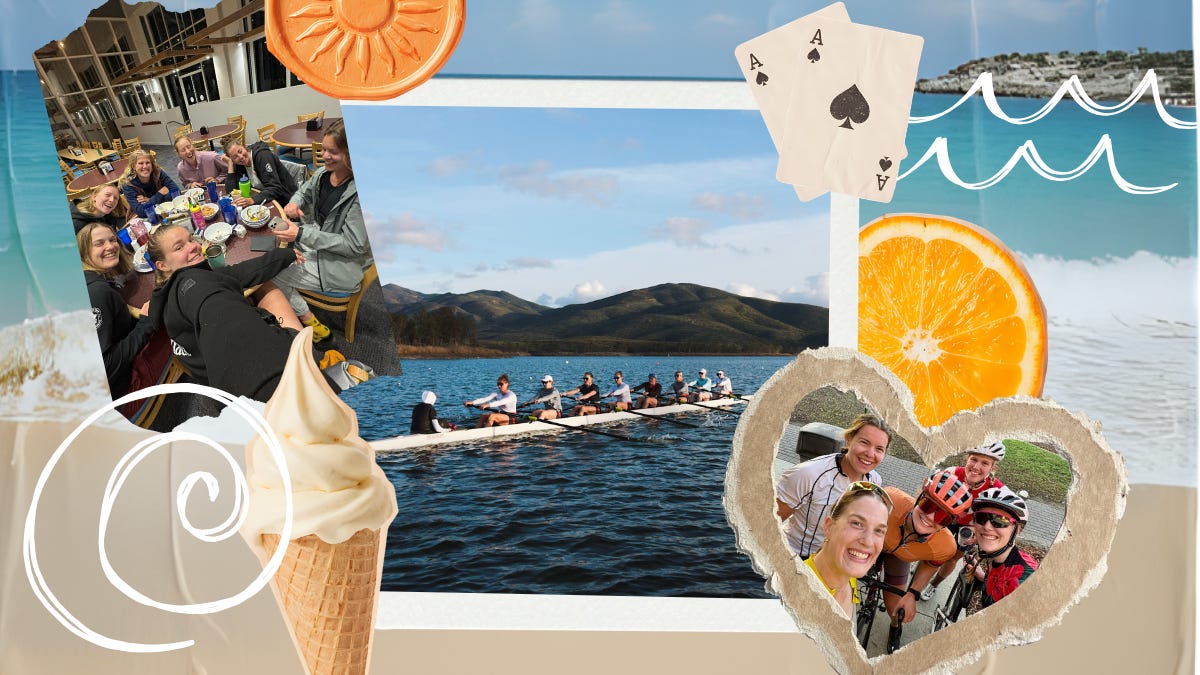
“The goal is to toe the edge of a cliff, and stay there.” - Coach Tom
I scored the jackpot in February. For nearly the entire month, I’ve been enjoying an all-inclusive paid vacation with friends in 20-degree weather. The only catch: putting in over 26 hours of training per week.
Last month, the women’s and men’s Canadian Rowing team have been training hard at Chula Vista Elite Athlete Training Centre, just outside of San Diego, California. The facility offers the best all-in-one experience for endurance athletes. Food, lodging, strength training, and of course, rowing are all offered from one venue. When you need to fit in three sessions in a day, cutting out commuting, food prep, and cleaning is a serious game-changer. That said, even paradise has its spiders— you just have to know where they hide and come prepared with a cup and a piece of paper.
Pre-Camp Mental Preparation
Prior to heading off to California, the women’s team met with our mental performance coach, Geoff, to set our intentions for the camp and identify markers to check into our progress. We broke into groups to discuss opportunities the camp would offer and the difficulties we might encounter. Talking about what may negatively impact us is a strategy for productively dealing with these issues in the future. It is inevitable that some people will struggle with aspects of the training camp, such as:
Distanced from partners, family or friends,
Meal redundancy,
Limited personal space,
Difficulty balancing work, school, or other commitments, and
High volume fatigue.
We discussed potential solutions to these issues, emphasizing that each individual is encouraged to speak up if they need space, support, or an adjustment to the training. 27-hour training weeks with little freedom to personally reset during the day can be difficult; however, they are not unmanageable with individual strategies.
In our sports performance meeting, we also reflected on the opportunities a training camp provides and made a plan to capitalize on these advantages so we can utilize our resources to their fullest potential. Some examples that came up in conversation included:
Fewer distractions,
High on water volume,
Chances to experiment, and
Improve personal connections.
The all-inclusive resort analogy wasn’t much of an exaggeration, except unfortunately minus bottomless margaritas. With all our training needs available in one location, there is no need to plan commuting, cooking, or any other logistics like at home. With that mental load released, it is much easier to apply a deliberate focus to our training and recovery, which is necessary to adequately adapt to the high rowing volume. Many sessions on the water give us a chance to experiment with new technical changes or race strategies in a low-stakes environment. This kind of experimentation is absolutely crucial for discovering ways of rowing that work for you in an environment that supports exploration. Finally, this camp provides ideal circumstances for connecting more deeply with one another. Living, eating, and spending downtime together is not something we always get to do at home because of variable living locations and commitments outside of rowing. Training camps effectively remove that barrier, giving us time to chat, play cards, do arts and crafts, and learn about the individual, separate from their athletic identity.
What actually happened
An example, direct from my training journal, when the light of camp was dimming:
“Today was a doozy”, February 24
“Sometimes I think, what the heck is the point of working so hard if I’m not seeing any improvements. Maybe that’s a bit dramatic. How are you defining improvement? If you’re showing up with the intent, something is probably moving; you’re just not aware of it yet. Breathe it in, let it out.”
It is almost natural to fall into the negativity bias that actively works against our best interests. When I don’t explicitly reflect on evidence to back myself, it seems like I default to a scrutinizing inner narrator, and usually the high-volume monster brings it out of me. When I catch myself flushing down the toilet bowl that is my inner critic, I ask myself, “Where is the proof?”
Am I being overly critical of a practice that taught me something, rather than setting a personal best?
Did I show up with an attitude that primed my mind for curiosity and the personal security to welcome feedback?
Did I optimize my preparation by eating enough and getting adequate sleep?
Am I just looking for external reassurance rather than trusting my personal process?
More often than not, the answer is in one of these questions. Becoming a mature athlete isn’t about diminishing these thoughts altogether; when they show up at the party uninvited, acknowledge they’re there and choose to have fun anyway.
A journal entry on courageous optimism:
“Twas the night before Matrix”, February 11
“What a privilege it is to have absolutely no idea how tomorrow is going to go. The last time a raced in a sculling boat? Couldn’t tell ya, which means expectations are low and experimentation is high. So glad I get to practice these things.”
This kind of thought process has personally shifted me from an extremely anxious racer to one who finds the play in sport. The idea of practice is so apparent that it removes unnecessary pressure to perform. Being realistic about where I’m at isn’t undermining my abilities; it’s recognizing how essential these experiences are to developing the specific skills I need. Our matrix consisted of 9, 1km races in doubles, switching partners between each piece. The short distance and the wide variety of race strategies and techniques optimized the conditions for discovering something new.
The entry from the next day:
“Participation ribbon”, February 12
“What a rollercoaster of highs and lows. Some races felt automatic, like my body knew where to go and I just had to apply the pressure. Others, like a battle with each stroke— exhausted and in disbelief at how slowly the meters were passing. Anyway, I kept a high rate even when my handles were wet and only caught one crab.”
Idrettsglede for alle
Idrettsglede for alle, translated as “joy of sport for all” is the Norwegian framework for supporting high performance sport.1 One of the model’s central philosophies is that each young athlete receives a participation trophy. Two years ago, I would have treated that idea with disdain, believing recognition that wasn’t ‘properly earned’ by winning over someone else was undeserved. The results from the recent Winter Olympics speak for themselves; there is a reason Norwegian athletes who developed under this model succeed, and it has to do with fostering intrinsic motivation. When our performances are measured by ranking, it reinforces the idea that our worth is dependent on external validation. An overreliance on external rewards defines our ideas of what improvement and success are, and is a surefire way to extinguish an inner spark.
I didn’t come away from the day with dominant performances, which would’ve devastated the version of me that used those kinds of outcomes to define worthiness. The good news, I’ve redirected my attention and redefined what a win looks like. I tried, I learned, and only one crab over 9 pieces with wet handles in a sculling boat is a feat.
I learned, biked a lot, spent time with my teammates, and somehow missed the tan. On to our selection period for the World Cup!
International Platform on Sport and Development. (2011). Sport policy document 2011–2015. https://www.sportanddev.org/sites/default/files/downloads/sportpolicydocument2011_2015_1.pdf
What a privilege, what a gift 🎁